


Due to affordability issues that force many younger families out of the market, the average first-time homebuyer in the United States is now 40 years old, a record high!
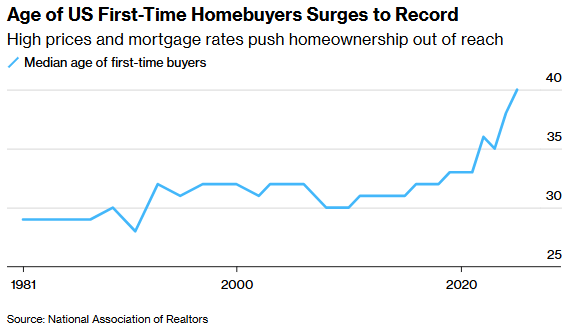
According to the National Association of Realtors®' annual profile of homebuyers and house sellers, the median age of first-time buyers increased to 40 in 2025 from 38 the previous year, and it is significantly higher than 33 just five years ago.
This year, the percentage of all house purchases made by first-time purchasers dropped to 21%, the lowest level since 1981. At the same time, cash purchasers made up a record-breaking 26% of sales. The record low share of first-time buyers emphasizes the real-world effects of a housing market starving for affordable inventory. The effects on the real estate market are profound. As a result, today's first-time homebuyers are expected to experience fewer moves during their lifetimes and are creating less housing wealth. The percentage of married couples who made their first purchase was constant at 50%, with 10% of first-time purchasers being men and 25% being women.
The median household income for first-time homeowners in 2025 was $94,400, which was marginally lower than the previous year but still much more than the $81,604 national median income.
First-time purchasers who could afford to put down cash aimed for more manageable monthly payments, and the average down payment was 10%, the highest percentage since 1989.
Unlike previous years when a gift or loan from a friend or relative was more prevalent, first-time buyers were more likely to use financial assets (26%) or personal savings (59%) for their down payment.
First-timers have to rely completely on their personal funds to put together a down payment for their home purchase without equity built up in a home that they already own and can sell. Many first-time purchasers are faced with a monthly payment they just cannot afford, so many choose to stay renters for the time being, especially with a tiny down payment and mortgage rates remaining above 6%.
Homebuyers who are compelled to postpone their first home purchase until age 40 are losing roughly $150,000 in equity on their starter house in comparison to those who buy at age 30. Inadequate housing supply is the primary cause of the affordability crisis, therefore today we need to concentrate on policies that alleviate it. Since home prices are at all-time highs and mortgage rates are high, affordability is still a major problem for first-time buyers.
Everyone is impacted by the present affordability issues in the housing market, but first-time homebuyers are particularly affected. These purchasers are absent from the housing market because many starter-level homes are staying on the market longer and getting greater price reductions, which makes it harder for those starter-home sellers to acquire more expensive properties.
The percentage of married couples who made their first purchase was constant at 50%, with 10% of first-time purchasers being men and 25% being women. The median household income for first-time homeowners in 2025 was $94,400, which was marginally lower than the previous year but still much more than the $81,604 national median income. First-time purchasers who could afford to put down cash aimed for more manageable monthly payments, and the average down payment was 10%, the highest percentage since 1989.
Unlike previous years when a gift or loan from a friend or relative was more prevalent, first-time buyers were more likely to use financial assets (26%) or personal savings (59%) for their down payment.
First-timers have to rely completely on their personal funds to put together a down payment for their home purchase without equity built up in a home that they already own and can sell. Many first-time purchasers are faced with a monthly payment they just cannot afford, so many choose to stay renters for the time being, especially with a tiny down payment and mortgage rates remaining above 6%.
Homebuyers who are compelled to postpone their first home purchase until age 40 are losing roughly $150,000 in equity on their starter house in comparison to those who buy at age 30.
Inadequate housing supply is the primary cause of the affordability crisis, therefore today we need to concentrate on policies that alleviate it. That entails opening up new construction as well as unlocking current inventory. According to the NAR research, the median age of all homebuyers rose to a record-high 59, and the average return buyer is now 62, the highest age ever.
These patterns are partially related to the nation's shifting demographics, as the sizable baby boomer generation is now between the ages of 61 and 79, but they also show that those who are at or close to retirement age are increasingly controlling the housing market. Many of these buyers probably used a significant amount of equity from the sale of a previous property to pay for their new home, and a staggering 30% of repeat buyers paid cash and did not finance their purchases.
In order to mitigate some of the effects of rising mortgage rates, the average repeat buyer paid a sizable down payment of 23%, which was significantly larger than the median 10% down payment for first-time buyers.
Notably, the percentage of purchasers with children under the age of 18 dropped to a record low of just 24%. This trend was probably influenced by both declining birth rates and homebuyers' advancing ages.
See Here For Homes For Sale Perfect For First Time Homebuyers