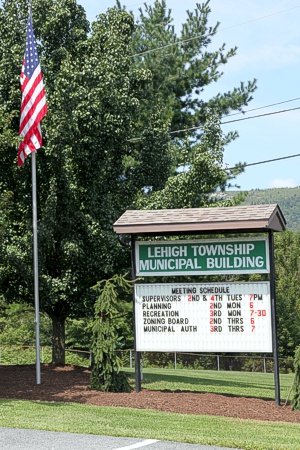
On Wednesday, June 18, locals gathered at the Lehigh Township Volunteer Fire Company to hear an engaging presentation on creating a program for preserving open space in the township, as the township's rural identity is being eroded by spreading development.
Lehigh Township resident and Wildlands Conservancy preserve manager Michael Hock described how the community's farms, forests, and other natural resources could be permanently safeguarded under a voter-approved open space preservation program. The purpose of the meeting was to increase public support and knowledge for a referendum on open space land preservation that will soon be on the ballot. Should the proposal be authorized, Lehigh Township would be able to prevent rapid growth from destroying undeveloped areas, including farms, wetlands, woods, meadows, and floodplains. Conserving land eventually improves quality of life, saves the township money, and safeguards natural resources. Preserved open spaces lessen financial burdens and help prevent future tax rises, in contrast to residential expansion, which raises expenses for services like roads, schools, and emergency response.
Additionally, preserving land protects clean air and water, helps local farmers, encourages health and recreation, and raises the value of nearby real estate. Land preservation will support the preservation of rural character, the ecology, and the well-being of communities in the face of development pressures. County programs for preserving farmland and municipal open space initiatives differ primarily in their eligibility, flexibility, and purpose. The primary goal of county farmland preservation is to safeguard superior agricultural land. It is quite competitive due to its strict eligibility requirements, which include minimum acreage, particular soil types, and other requirements. Many farms in Lehigh Township do not score strongly enough to be eligible as a result.
Municipal open space initiatives, on the other hand, are more expansive and adaptable. They prioritize protecting forests, natural resources, and ecologically delicate places in addition to farms. The process is less competitive and more accessible to local landowners because the municipality establishes its standards for choosing sites to protect. The proposed program would be financed by a 0.25% increase in the earned income tax, or around $100 per working resident each year. Those who receive Social Security are exempt. The township's parks or land preservation initiatives would be the only uses for that funding.
To maintain the land's protection without giving up ownership, participating landowners would willingly sell the development rights to their property. The presentation also discussed the expensive effects of unrestrained residential growth. Governments generally spend $1.16 for services like road maintenance, schools, public safety, and drainage infrastructure for every $1 in tax income brought in by residential growth. On the other hand, farms and open space only cost $0.37 for every dollar gained. A thorough presentation on the county's open space preservation initiatives was then delivered by Sherry Acevedo, conservation coordinator for the Northampton County Division of Parks and Recreation.
The department has an extensive range of duties that include overseeing the Livable Landscapes Grant Program and managing more than 2,360 acres of public lands, along with 22 parks, trails, and preserves. Through competitive grant financing to local municipalities, conservancies, and land trusts, this program supports initiatives related to open space acquisition, agricultural preservation, environmental restoration, recreation development, and education. The 2014 Return on Environment report by the Lehigh Valley Planning Commission, which demonstrated that green infrastructure along streams alone saves taxpayers over $110 million a year in avoided expenses for pollution control, flooding, and water delivery.
It is now more important than ever for the county to strike a balance between community development and conservation. The Lehigh Valley loses over 2,000 acres of open space a year to typical development as a result of the growth of homes, businesses, and industries. Natural resource conservation, a robust parks and recreation system, improved greenways and rivers, farmland preservation, historic and scenic landscape protection, and community access expansion through partnerships and education are among the objectives of the Livable Landscapes Plan. Real funding has supported these objectives: since 2006, 3,598 acres of open space have been preserved throughout Northampton County thanks to $21.7 million in county grant awards and $41.47 million in municipal funds.
Ryan Shaw, the Administrator of Farmland Preservation for Northampton County, then gave a summary of the county's initiatives to save agricultural land under Pennsylvania's Farmland Preservation Program.
The county has conserved 268 farms totaling 19,692 acres since 1989, and 19 more farms totaling approximately 1,200 acres are presently under construction. Particularly in Lehigh Township, three more farms are being prepared, and 14 farms totaling 1,062 acres have already been conserved. The township still has an estimated 3,500 acres of farmland that could be preserved in the future.
The agricultural conservation easement, a voluntary, legally binding contract wherein landowners sell the development rights to their property and permanently limit it to agricultural use, is the main weapon utilized. To be eligible, land must meet specific requirements related to acreage, agricultural activities, and soil quality. Based on criteria such as soil capacity, the possibility of grouping with other protected areas, the farms' present agricultural use, and development risk, they are ranked. Regarding the proposed open space program and its potential economic effects, locals expressed a range of opinions, including support, worry, and interest.
The township now collects a 1.2% EIT, and a decrease in property values might have an impact on real estate tax revenues. It is warned that with current zoning and amendments to land use regulations aimed at restricting warehouse expansion, now might not be the best time to pursue the program. Although it was made clear that landowners can apply directly to Northampton County for preservation, many nearby properties don't fit the stringent requirements set by the county. This vacuum would be filled by the proposed township-level program, particularly through partnerships that enable the county to use municipal financing for assets that would not otherwise be eligible.
More farmers would be eligible for collaboration between the township and county, and maintained farms provide food and community value. Although 305 lots might have met the minimum size requirements, the county had rejected seven farms in Lehigh Township because of eligibility concerns. Even if the site is sold, officials emphasized that once a property is safeguarded, the restriction is irreversible. Owners of real estate may also decide to give up their development rights for free. Furthermore, protected lands continue to be legally conserved, and any money previously raised must be used for preservation even if the initiative is unsuccessful.